For Business Analysts & IT Decision Makers

SquidScanner 101

A clear, non-technical overview of automated reconnaissance for the people who recommend security tools.

No jargon. No deep technical dive. Just what you need to evaluate whether SquidScanner is the right recommendation for your IT and security teams.

First scan is free • Pay per scan after that

THE REALITY TODAY

Manual reconnaissance is slow, inconsistent, and expensive to scale.

Security teams spend days or weeks manually enumerating assets
Results vary wildly depending on who runs the tools
Executive stakeholders receive raw technical data instead of clear risk insights
Expensive consultants are often brought in just to do discovery work

This creates real problems for the people recommending tools:

  • Difficulty proving ROI of security investments
  • Inconsistent deliverables across projects
  • Long time-to-value for new security initiatives
  • Hard to justify budget when outputs are technical and hard to understand
HOW IT WORKS

SquidScanner in four simple steps

Designed so anyone on the team can run high-quality reconnaissance.

1

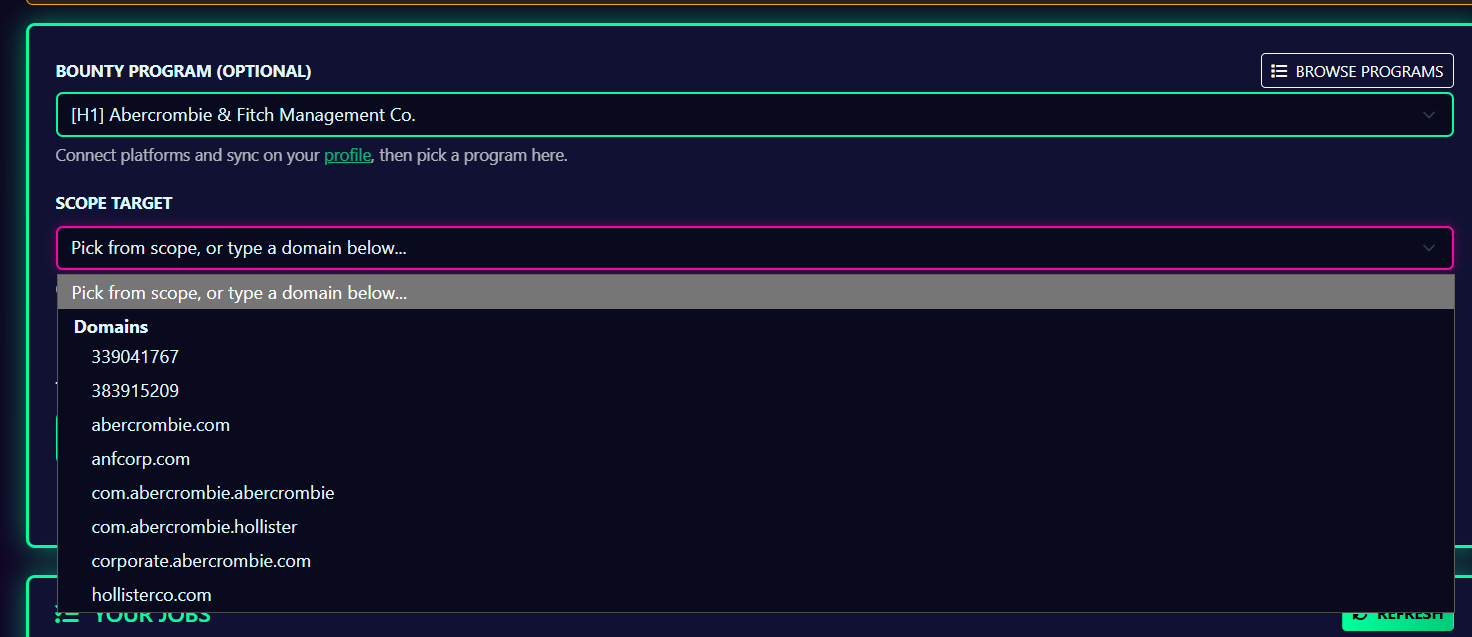
Enter a Domain

The analyst or engineer simply enters the target domain. No complex configuration needed. Works for any public-facing asset.

2

Autonomous Agents Work

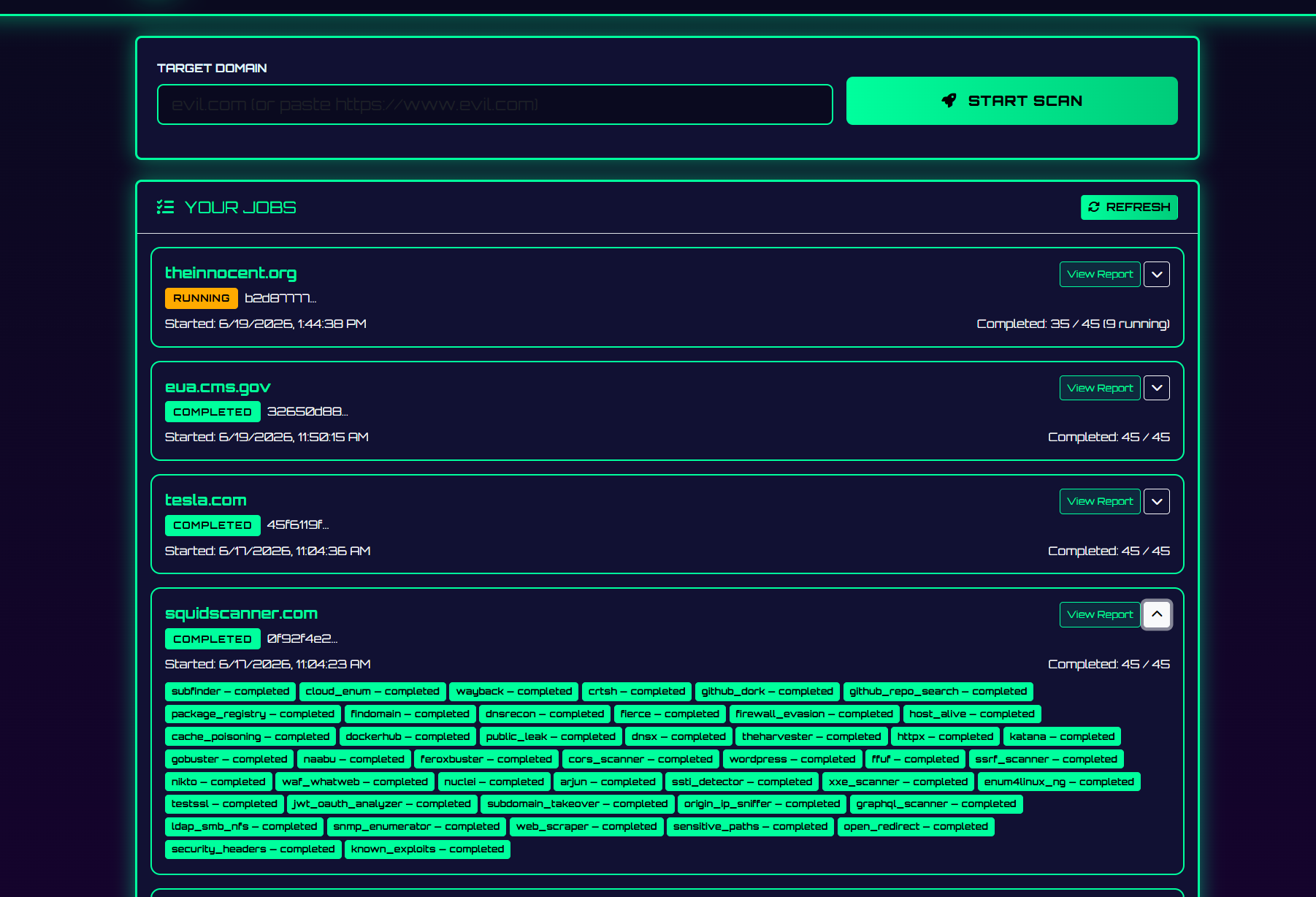
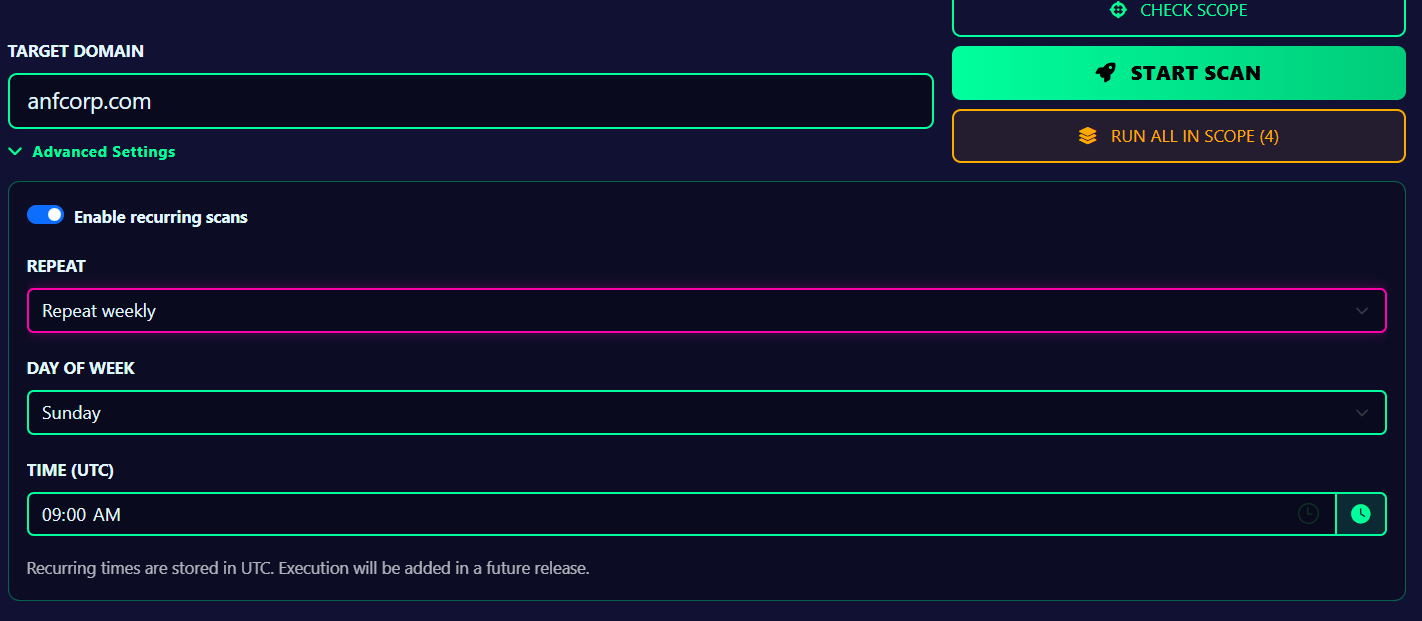
30+ specialized AI agents run security tools in parallel — subdomain discovery, historical archive analysis (Wayback), certificate transparency (crt.sh), GitHub dorking, public leak detection, port scanning, vulnerability detection, and more.

3

AI Analyzes Everything

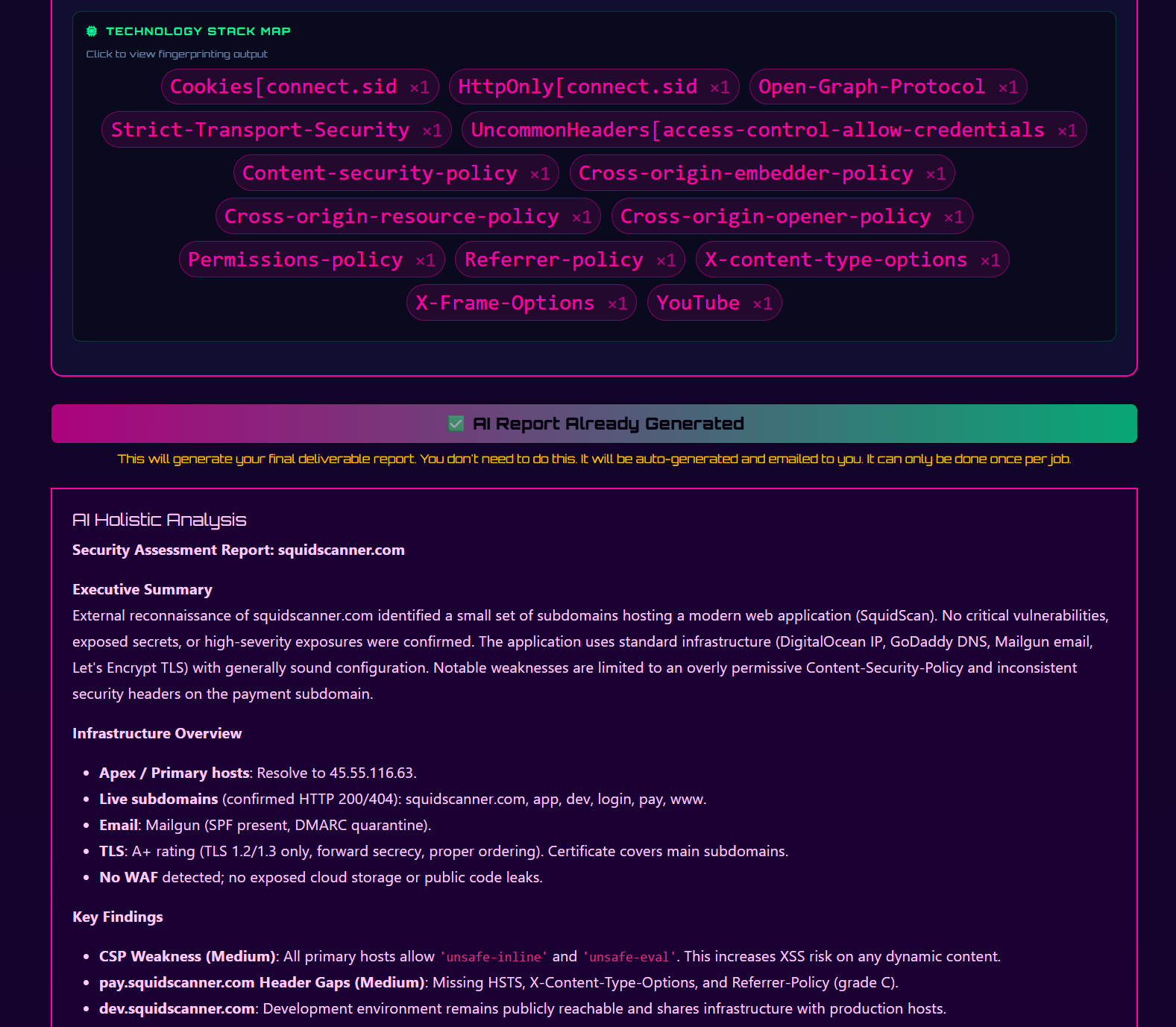
Grok (xAI) synthesizes all findings into a professional executive report with clear risk context, prioritized recommendations, and business-friendly language — not just raw technical output.

4

Share Actionable Insights

Deliver a clear, stakeholder-friendly report instead of hundreds of pages of raw tool output. Reports are shareable, auditable, and ready for executives or clients.

2

Autonomous Agents Work

Specialized AI agents run 30+ security tools in parallel — subdomain discovery, historical archive analysis, certificate transparency, GitHub dorking, public leak detection, port scanning, vulnerability detection, and more.

3

AI Analyzes Everything

Grok (xAI) synthesizes all findings into a professional executive report with clear risk context and prioritized recommendations.

4

Share Actionable Insights

Deliver a clear, stakeholder-friendly report instead of hundreds of pages of raw tool output.

What makes SquidScanner different

Most tools stop at raw data. We go further.

AI Executive Reports

Instead of dumping technical findings, SquidScanner produces clear, business-relevant reports powered by Grok. Stakeholders actually read them — no translation layer required.

Fully Autonomous

No need to babysit 15 different tools. The system runs the entire discovery and analysis pipeline with minimal human intervention — from subdomain enumeration to final report.

Built-in Guardrails

Strong legal and operational controls (including self-service domain opt-out) so you can confidently recommend the tool without compliance concerns.

Rapid Time-to-Insight

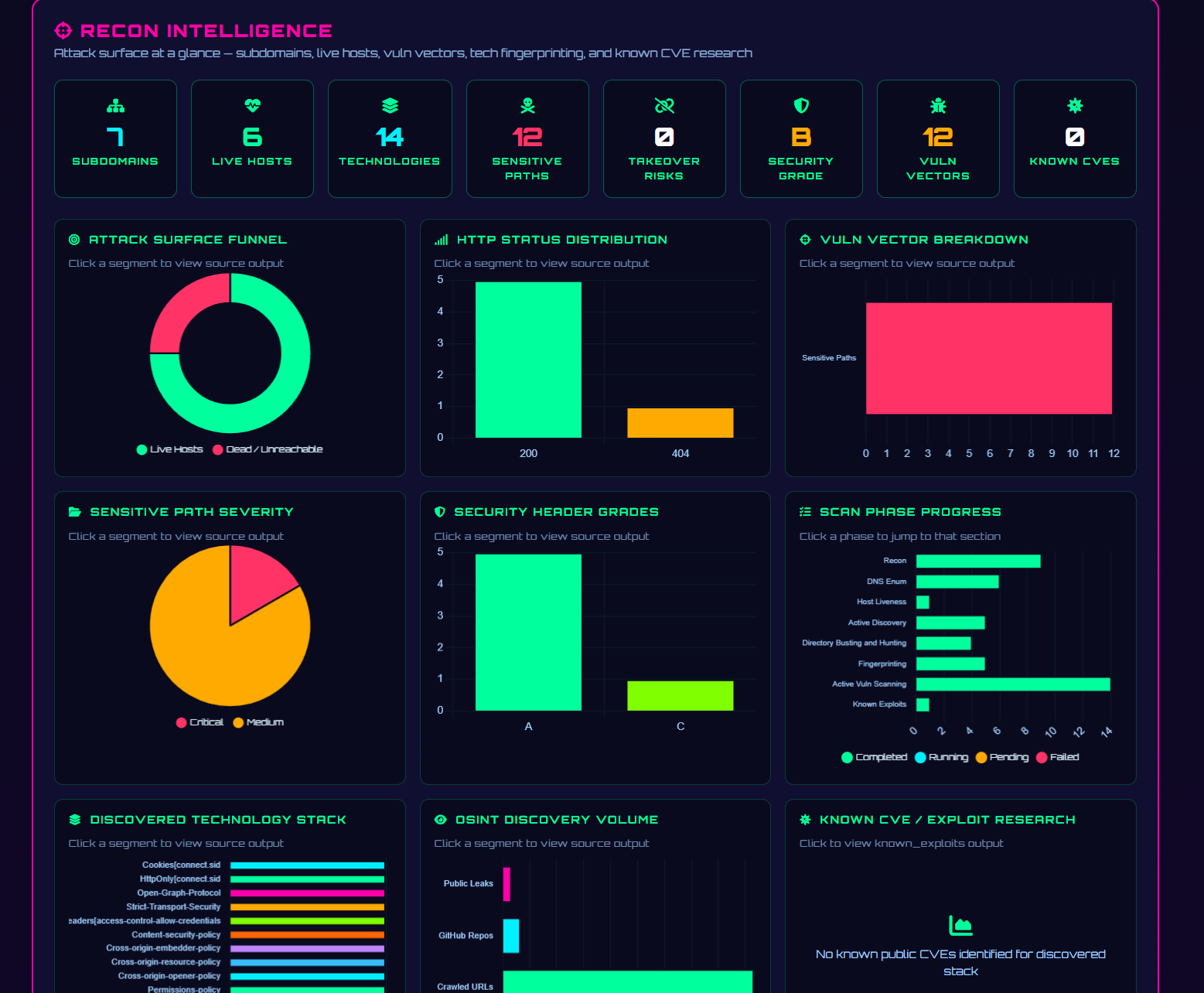
Get comprehensive attack surface visibility in hours instead of days. Ideal for security assessments, M&A due diligence, and continuous monitoring programs.

Consistent Quality at Scale

Every assessment follows the same rigorous methodology. No more variance based on who is running the tools or how much time they have.

Modern Attack Surface Coverage

Goes beyond traditional scanning with historical data (Wayback), certificate intelligence, GitHub reconnaissance, and public leak detection.

What matters when you’re recommending a tool

Faster Time-to-Value

Teams get meaningful results in hours instead of days or weeks. Great for proof-of-concept, pilot projects, and time-sensitive assessments.

Consistent, High-Quality Deliverables

Every report follows the same professional standard — no more depending on the experience level of the person running the assessment.

Stakeholder-Friendly Output

You can hand the final AI report to executives, risk committees, or clients without heavy editing. Reports are designed to be read, not just filed.

Lower Total Cost of Ownership

Reduces reliance on expensive manual consulting hours for discovery work. One token = one complete, AI-analyzed assessment.

Responsible & Compliant by Design

Built-in domain opt-out, strong audit logging, and clear terms of use make it easier to get legal and procurement approval.

Modern AI Capabilities

Uses frontier models (Grok) for synthesis — not just another wrapper around old scanning tools. The AI understands context and prioritizes findings.

Comprehensive Attack Surface Visibility

Combines traditional scanning with modern techniques: historical data from Wayback Machine, certificate transparency logs, GitHub reconnaissance, and public leak detection.

Scalable & Repeatable Process

Perfect for continuous monitoring programs, regular assessments, or scaling security reviews across a large portfolio of assets.

COMPLETE TOOLKIT

Every Tool Has Its Own AI Agent

Below is the full list of reconnaissance tools SquidScanner runs, along with what each specialized AI agent accomplishes.

Subdomain & Infrastructure Discovery

  • subfinder — Discovers subdomains from dozens of public data sources and APIs.
  • findomain — Fast subdomain enumeration using multiple passive sources.
  • wayback — Analyzes historical web archives to find old or forgotten endpoints and parameters.
  • crtsh — Queries Certificate Transparency logs to reveal additional subdomains and certificates.
  • dnsx — Performs fast DNS resolution and wildcard filtering on discovered domains.
  • dnsrecon — Conducts comprehensive DNS reconnaissance including zone transfers and record enumeration.

Network & Service Scanning

  • naabu — Fast port scanning to identify open services and potential entry points.
  • httpx — Probes discovered hosts to determine live web services and technologies.
  • katana — Crawls websites to discover hidden paths, endpoints, and JavaScript files.
  • feroxbuster — Directory and file brute-forcing to find hidden resources.
  • gobuster — Directory, DNS, and virtual host enumeration.
  • ffuf — Flexible fuzzing for directories, parameters, and virtual hosts.

Vulnerability & Web Security

  • nuclei — Template-based scanning for known vulnerabilities and misconfigurations.
  • nikto — Web server scanner for outdated software and common vulnerabilities.
  • wapiti — Black-box web vulnerability scanner.
  • arjun — Parameter discovery to find hidden input fields.
  • ssrf scanner — Detects potential Server-Side Request Forgery vectors.
  • ssti detector — Identifies Server-Side Template Injection opportunities.
  • xxe scanner — Tests for XML External Entity vulnerabilities.
  • cache poisoning — Detects web cache poisoning risks via unkeyed headers and parameters.
  • graphql scanner — Discovers GraphQL endpoints and tests for introspection, auth bypass, and injection flaws.
  • web scraper — Deep content scraping to uncover hidden data, secrets, and sensitive information.

Specialized & Intelligence Gathering

  • github dork — Searches public GitHub repositories and code for secrets and internal references.
  • public leak — Scans paste sites and gists for leaked credentials or infrastructure details.
  • theharvester — Gathers emails, subdomains, and employee names from public sources.
  • cloudenum — Enumerates cloud storage buckets and resources.
  • package registry — Searches public package registries (npm, PyPI) for related projects.
  • dockerhub — Looks for publicly available Docker images related to the target.
  • jwt oauth analyzer — Extracts and analyzes JWT tokens and OAuth configurations.
  • cors scanner — Detects misconfigured Cross-Origin Resource Sharing policies.
  • firewall evasion — Tests for firewall filtering and potential evasion techniques.
  • snmp enumerator — Performs SNMP community string checks on network devices.
  • ldap smb nfs — Enumerates LDAP, SMB, and NFS services where exposed.
  • waf whatweb — Identifies web application firewalls and underlying technologies.
  • enum4linux ng — Performs SMB and Windows enumeration on exposed services.
  • testssl — Analyzes SSL/TLS configurations for weaknesses.
  • wordpress — Specialized scanning for WordPress installations and vulnerabilities.

Every tool runs inside its own dedicated AI agent that intelligently parses output and contributes to the final Grok-powered report.

Ready to see it for yourself?

The fastest way to understand the value is to run a real assessment on a domain you care about.

Start Free Trial

Questions? Email us at contact@squidhacker.com